



You measure the success of your website with analytics and clear goals: visits, clicks on the booking link, booked calls and time on site. As a rule of thumb: more than 2 minutes on site and, with 1,000 visitors a month, 1 to 2 inbound calls a week and 10 to 20 leads a month. Without visibility, even the best website can’t sell.
You don’t know what’s working and what isn’t.
You know this feeling for sure: you decide to go to the gym regularly. You train. You train. You train. After three months you look in the mirror and think: “Nothing has changed.”
Wrong. Your body changes after every single session. You just can’t see it.
Your website is exactly the same. You optimise it, you wait three months, you check your inbox and think: “Nothing has changed.” Meanwhile, people are visiting your website in the background. They’re probably even clicking on your booking link and booking a call there.
The only problem: you have no idea where that call came from. Maybe you think it came from LinkedIn because you’ve linked your calendar there. But very few people book a call for a service starting at €3,000 without getting a picture of you first. Maybe the call came through the website. You don’t know.
Start knowing your numbers. In every area:
- How many conversations do you have with potential clients? Coffee chats don’t count.
- How many sales do you make?
- How much revenue do you make? At the end of the day, likes don’t count.
- How many visitors do you get?
- How many people click on your booking link?
- How many people actually book a call through your website?
- How many deals do you close from enquiries that came through the website? Website leads are far warmer than cold outreach leads, for example.
These are the goals I set up in analytics.
For my clients I use Matomo Analytics to track all of this. There are all sorts of analytics tools for measuring your website’s numbers. In Matomo I always set up these goals:
- Booking page visited
- Calendar opened
- Call booked
- Newsletter sign-up
- Landing page visited
- Course purchased
- More than 10 minutes on the website
- Contact enquiry sent
- Webinar recording watched
Know your numbers. For your website to sell, it needs analytics and a solid structure. I walk you through the structure in the article Building a sales-optimised website.
How to calculate your visibility points.
0 visitors always means 0 calls. However great your website is: if you have no visibility, it can’t sell. You find out whether your visibility is good or bad by calculating your visibility points.
- Impressions of your posts from last weekOn LinkedIn or whichever other platform you’re active on. For me, that was six posts in one week with around 25,000 impressions in total.
- Visits to your websiteFor example, 312 visits.
- Newsletter emails sentFor example, 712 emails.
- Views of your latest YouTube videoFor example, 123 views.
- Listeners of your podcastFor example, 231.
Other sources that can create visibility: ads, TikTok, search engine optimisation, events and trade fairs. Now add it all up. In my example that comes to roughly 26,300 visibility points for this week.
Just doing the sum shows you how important it is to actively work on your marketing. No posts: 0 visibility points. No newsletter: 0 visibility points. No videos: 0 visibility points. You have to put something in to get something out.
Is your visibility good or bad?
Now you have your visibility points as a number. Here’s how to read it:
- 010 to 1,000 pointsYou’re invisible. Whatever kind of website you have, you’ll hardly get any calls. At this stage, don’t invest a single second in your website, your branding or any other stuff you could distract yourself with. Create content and post it.
- 021,000 to 5,000 pointsYou have minimal visibility. With an optimised website you might get one call in three months.
- 035,000 to 10,000 pointsYou have a little visibility. With a well-optimised website you might get one call in two months.
- 0410,000 to 20,000 pointsYou should already be getting around one call a week if your website is optimised.
- 0520,000 to 30,000 pointsThat should bring you around three to four calls a week if your website is optimised.
- 06Over 30,000 pointsYou should be getting more than three calls a week with an optimised website.
Bear in mind: newsletter visibility points are worth far more. You might have 200 newsletter subscribers, do nothing else for your visibility and still get one or two calls a week. This rating is only meant as a rough guide.
Time on site shows whether your website keeps people engaged.
Another thing you should check in analytics is time on site. The longer people stay on your website, the more likely they are to book a call with you. If time on site is high, you know people are engaging with your offer.
- 01Under 30 secondsYour time on site is abysmal. People aren’t engaging with your website at all. They’re gone more or less straight away. So you don’t get any calls through your website either.
- 02Under 1 minuteYour time on site is still poor. People aren’t engaging enough with your offer and your website.
- 031 minute to 1:30 minutesIf you have a one-pager, that’s already a good time on site. For a website with subpages it’s still poor.
- 041:30 to 2 minutesThat’s okay for a website with subpages.
- 052 to 3 minutesThis is the time on site I ideally aim for with clients. You’re doing well here.
- 063 minutes and upHere you’re in very, very good territory. This is high-flyer time.
In the week I wrote this, my time on site was over 4 minutes.
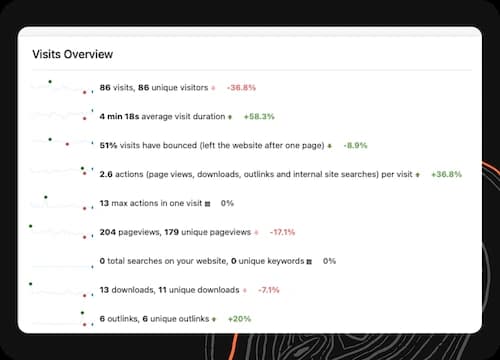
And it’s not just me. Of course, this can fluctuate from week to week. Three client websites for comparison:
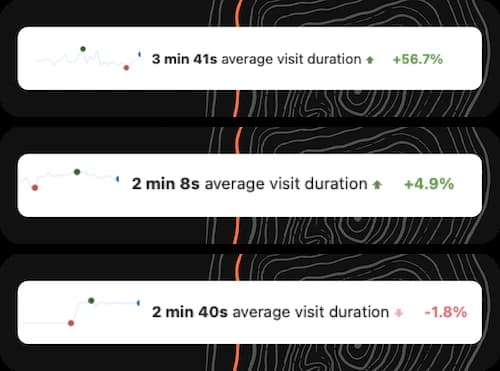
You can increase time on site by optimising your content, making sure the page loads reasonably fast, picking the visitor up again and again, offering real value and linking subpages sensibly. Nobody spends time on your site unless it’s worth their while.
The most important key figures at a glance.
If your website has no analytics, you can’t possibly know how much potential it holds or how much it even matters in your marketing. These are the key figures your website should track:
On top of that: 400 or more clicks a month to your website from your target audience.
If your numbers are below that, you’ll find possible causes in the 60 website mistakes that cost you enquiries. And if you want your website to sell: Book a call with Kris.
Frequently asked questions about measuring website success
How do I measure the success of my website?
With an analytics tool and goals, for example: booking page visited, calendar opened, call booked, newsletter sign-up and contact enquiry sent.
What is a good time on site?
For a website with subpages, 2 to 3 minutes is good, and from 3 minutes you’re in very good territory. For a one-pager, 1 minute to 1:30 minutes is already good.
How many calls should a website bring in?
As a rule of thumb: with 1,000 visitors a month, 1 to 2 inbound calls a week and 10 to 20 leads a month.
What are visibility points?
The sum of your reach from one week: impressions of your posts, website visits, newsletter emails sent, video views and podcast listeners.
How many visibility points does it take for a website to bring in calls?
From around 10,000 points a week, you should get roughly one call a week with an optimised website. Below 1,000 points you’re invisible.
Which analytics tool do I need?
There are several. For my clients I use Matomo Analytics.
Collecting testimonials that sell →Building a sales-optimised website: 8 key sections →The thank-you page after a booking: building trust before the intro call →How to create a sales page: bring in more revenue with your sales page →What does a professional website cost? My prices laid bare →60 website mistakes that cost you enquiries →Getting a website built: the process in 7 phases →Website check: the two-tab test in 10 minutes →Landing page structure: the LEAD-FIND formula in 8 sections →Creating a lead magnet: a freebie people actually want →Your website as a sales rep: 8 jobs it does for you →Building trust on your website: show, don’t tell →Positioning for service providers: stop being comparable →Irresistible offer: 5 steps to make it sell →Fake timers and co.: 5 manipulative tactics on websites →Becoming a premium service provider: be premium, don’t just charge premium prices →
