

With us, a website comes to life in seven phases: gathering information, ideas, concept, proposal, refinement, build and launch. We go through concept, proposal and refinement three times: for the first draft, the homepage and the subpages. It all ends with a launch on social media.
Everything that has to happen for a website to come to life.
Some people think I just push a few boxes around and suddenly there's a website. That would be very boring. In reality, there's quite a lot behind it.
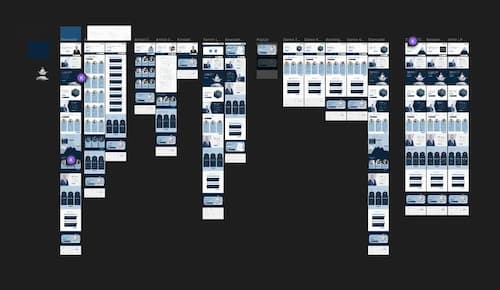
When a client decides to work with me, we go through several phases:
- The information gathering phase
- The ideas phase
- The concept phase
- The proposal phase
- The refinement phase
- The build phase
- The launch phase
I'll now give you a quick, punchy look at each of these phases.
01 / Gathering information
First, I want to understand my client.
At the start, there are a few things I want to know about my client:
- What does my client already have that we can work with?
- How can we present it in a sales-optimised way? Their expertise shouldn't just be explained, it should be shown in a way people actually get.
- What does my client still need to create or get hold of to come across as professional? Photos, for example: which poses and locations make sense? What feeling do we want to spark? Or testimonials: what's the best and easiest way for them to collect them?
- What vision does my client have for their business over the next few years? That's how we make sure the website isn't just great for one year.
- How does my client want to come across?
- Who exactly does my client want to speak to? And how do these people want to be spoken to?
How to collect sales-optimised testimonials is covered in my guide to testimonials.
02 / Ideas
First ideas and sample designs.
In this phase I bring in my first ideas. I show my client the ideas and angles that come to mind based on the information we have. We discuss them and sharpen them together.
I show my client sample designs by other designers. They tell me what appeals to them and what doesn't. It's one of my clients' favourite phases.
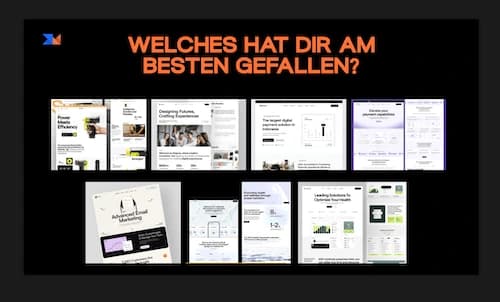
This lets me understand exactly: which details does my client pay attention to? Are there things that overwhelm them? Are there things their target audience definitely doesn't want?
Needless to say, what we end up with looks nothing like the sample designs. But it helps me pick up on nuances my client would probably never have been able to put into words. That saves us time in the process.
03 / Concept
A blank page and the briefing.
This is where I think through exactly how I could present the information I now have. As you can see, a fair bit of groundwork happens before the first draft.
I always start with a blank page and the briefing from my client. Thanks to the ideas phase, I usually already have a clear picture in my head, which I then bring to life. I know which feelings I want to spark and who I want to speak to. I express that in the design.
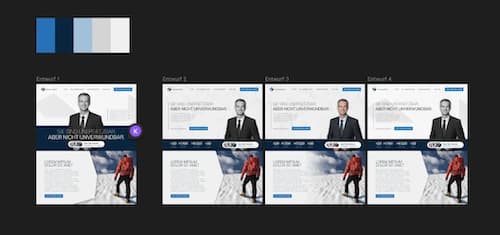
In the first draft I design the first two areas of the website: the header and the section that creates problem awareness.
04 / Proposal
The design goes to the client, with 5 questions.
Once the concept is in place, I send my client the design. It comes with five questions that show them exactly what matters in their feedback at this point.
That way my client can give me really good feedback that moves us forward. It's easy for them and they don't have to work anything out themselves.
05 / Refinement
Working in the feedback, three times round.
In this phase I implement my client's feedback and bring in any further ideas they'd like to see.
We go through the concept, proposal and refinement phases three times in total. Step by step, that gets us to the best result for my client.
06 / Build
The designs get built.
Once the designs are finalised, they get built. In the meantime we gather the last files and bits we still need. New photos, testimonials and videos, for example.
07 / Launch
The launch on social media.
You've probably seen it on my LinkedIn already: at the end of our work together, I support every one of my clients with a launch of their new website on social media.
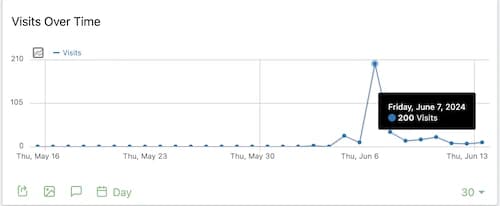
Right from go-live, that brings 100 to 400 visitors to the website in a single day. Sometimes the first calls get booked on day one.
Calls aside, a launch like this always creates strong visibility and presence. You rack up a few touchpoints straight away. And a buying decision usually takes seven or more touchpoints.
Those are the phases I go through with my clients. If you want to know what this could look like for you, so that you end up with a custom-designed, sales-optimised website, go for it and grab a free, no-obligation call: Book a call with Kris.
Frequently asked questions about the process
What's the process when I have a website built?
With us, it's seven phases: gathering information, ideas, concept, proposal, refinement, build and launch. So a fair bit of groundwork happens before the first draft.
How many feedback rounds are there?
We go through concept, proposal and refinement three times: for the first draft, the homepage and the subpages.
What do I need to contribute myself?
Information about your offer, your target audience and your vision. On top of that come photos, testimonials and videos. We sort out what's still missing right in the first phase.
How do I give good feedback on a design?
With every design you get five questions that show what matters in your feedback. So you don't have to work anything out yourself.
What happens when the website launches?
I support you with a launch on social media. At go-live, that brings 100 to 400 visitors in a single day, and sometimes the first calls get booked on day one.
Collecting testimonials that sell →Building a sales-optimised website: 8 key sections →The thank-you page after a booking: building trust before the intro call →How to create a sales page: bring in more revenue with your sales page →What does a professional website cost? My prices laid bare →60 website mistakes that cost you enquiries →Website check: the two-tab test in 10 minutes →Landing page structure: the LEAD-FIND formula in 8 sections →Creating a lead magnet: a freebie people actually want →Measuring website success: the numbers you need to know →Your website as a sales rep: 8 jobs it does for you →Building trust on your website: show, don’t tell →Positioning for service providers: stop being comparable →Irresistible offer: 5 steps to make it sell →Fake timers and co.: 5 manipulative tactics on websites →Becoming a premium service provider: be premium, don’t just charge premium prices →
