



A LinkedIn content strategy needs 4 pillars: a clear content strategy, a routine and consistency, analysis and iteration, and idea generation. Give every day a category, plan all of your content for the week in one go on a fixed day, and spend 15 minutes every Monday looking at which posts brought you leads, bookings and clients. And when you have ideas: write them down straight away.
LinkedIn content strategy: it takes 4 pillars.
When I had just started on LinkedIn, my biggest problems were that I:
- didn’t know what to post,
- had no idea how to create posts that actually bring in clients,
- didn’t know what a sensible routine for creating content would look like for me.
I thought: I’ve got nothing relevant to say on LinkedIn anyway, because nothing interesting happens in my life or my business. But that’s nonsense. These are so-called “limiting beliefs”. They limit your potential. If that’s what you think, let those thoughts go. You have something relevant to say too. Or have you learned nothing in life?
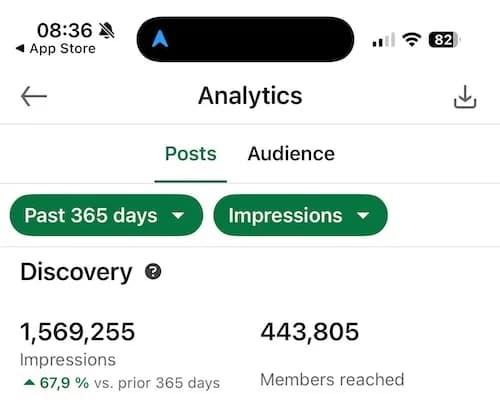
By now I have more than 13,000 followers on LinkedIn, and in 2025 I generated more than 1.5 million impressions in total. In revenue, that’s a six-figure sum for me.
It takes 4 pillars to succeed in the content game on LinkedIn:
- A clear content strategyYou can’t generate leads on LinkedIn by simply writing something about your private life every day. You may and should show yourself as a person, but it’s just as important to create content that makes your dream clients want to talk to you.
- A routine and consistencyI didn’t get 1.5 million impressions by posting only twice a week. The more you post, the more chances you have to learn.
- Analysis and iterationIf you create posts but never understand which kind of posts or which ideas bring you client enquiries, LinkedIn is like playing the slots for you. Pure chance.
- Idea generationA post is only as good as the idea behind it. You can have the best formatting, the best hook technique and the perfect image. It’s all worth nothing if the idea behind it doesn’t hit.
Why does all this matter? In Germany, many people don’t ask: “Have you got a tissue?” They ask: “Have you got a Tempo?” That’s exactly what we want to achieve with you as a business owner. When people think of your service, they should think of you. For that, you need to be known for your topic on LinkedIn.
Pillar 1: a clear content strategy with 4 content pillars.
Let’s be honest: you’re not on LinkedIn to hang around. You want to win clients. That’s fine, and that’s a good thing. To win clients, you can’t just post blindly. What you need are 4 content pillars.
These are my 4 content pillars:
- Website strategy and conversions
- Web design success stories
- Psychology in web design
- Practical website tips
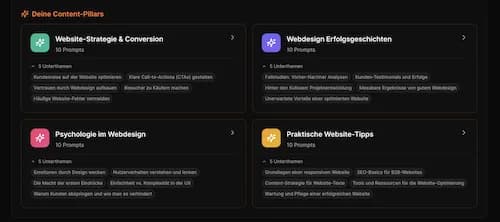
Each of these content pillars has another 5 subtopics. For website strategy and conversions, for example: optimising the customer journey on the website, designing clear calls to action (CTAs), building trust through web design, turning visitors into buyers, avoiding common website mistakes.
When I create content, I work from one of the content pillars. That way I never run out of ideas for my value posts.
How to create your content pillars
- Start a note in your notes app.
- Think about which 4 main topics are relevant in your industry and that you can create content about.
- For each main topic, come up with at least 5 further points you can write posts about.More is welcome.
Your content plan: give every day a category.
Now you have your content pillars. Next, you need to know what to post when. My recommendation:

- Monday: value postDraw on your 4 pillars for this.
- Tuesday: lead getter postA post with a freebie, for example, that brings you leads.
- Wednesday: client story or testimonialSuper important. Post at least 1 testimonial every week.
- Thursday: value post
- Friday: personal story postSomething personal. Things you’ve learned, things you’ve experienced, your values. People don’t just buy your service. They buy you as a person.
- Saturday and Sunday: repostsPosts you published 4+ months ago, simply repost them here.
What does that get you? Reach, leads, you build your personal brand and you establish yourself as a trustworthy business owner in the market. How to build a freebie for Tuesday is covered in the article Creating a lead magnet. And for Wednesday, there’s my guide to testimonials.
Pillar 2: a content routine and consistency.
It works best if you pick ONE fixed day, Monday or Friday for example, on which you plan all the content for your week. In one go. Simply block out the whole morning for it.
- Get yourself a tea or coffee.
- Sit down at your desk and put on noise-cancelling headphones.
- Put on classical music or binaural beats.
- Set a timer for 50 minutes and work on your content with full focus for those 50 minutes.
- Feel free to open your notes with your ideas and your content pillars as well.
- Take a 10-minute break. Then do it again. Until you’re done.
Important: Switch your phone off or put it on silent in another room. Eliminate distraction.
Posting alone isn’t enough
A month in which there was only posting on LinkedIn and nothing else. The result: just one client came in, through a referral.
About 2 hours on LinkedIn on Mondays, and about 45 minutes a day on the other days (Tuesday to Friday). The result: 2 new clients through the LinkedIn routine.
This is the routine. Feel free to copy it:
- Post contentWithout focusing on likes and comments.
- Comment on and like new posts from 5 to 20 LinkedIn influencers
- Go through all comments under your own post and reply to them
- Reply to the messages in your inbox
- Message 10 to 20 new peopleFrom profile visitors, likes or new connections.
- Connect with 100 people from your target audience every week
This can be done in 30 minutes to an hour. I know people who spend 2 or 3 hours a day on LinkedIn. What do they do? Nothing that moves their business forward. Why? Because they haven’t written down their routine. Yes, it’s that simple.
Write your LinkedIn routine down in your notes. Add a link to every step where it helps. Open the note every morning and work through it. Like a robot. It sounds worse than it is. Scrolling aimlessly through LinkedIn posts is what’s bad.
Comments and messages: every comment is like a post.
Make a list. Write down 20 or even 30 LinkedIn influencers. On the left you put the name, and on the right the direct link to that person’s “Posts” tab. That takes you straight to their posts. It makes the whole thing immensely efficient.
Instead of writing a comment like “Great post!” or “Totally agree.”, I write comments in these 4 formats:
I write something funny that comes to mind.
I add something to the post. No LinkedIn post can cover everything there is to say about a topic.
Praise the person and say why.
If you see something differently, say so. Explain why, and stay respectful.
If the author gets 10,000 views on their post and your comment has the most likes, your comment is shown right at the top. For you that means: connection requests, profile visitors, messages. You get to ride the wave the other person has already set in motion.
And write messages. You don’t have to be the pushy salesperson. I like asking profile visitors why they’re visiting my profile. That tells me where people are finding me and which part of my marketing is working well right now. I say thank you and pitch nothing. My content does the work for me.
Pillar 3: analysis and iteration.
If you only post without ever analysing your content, you’re simply wasting potential. So here’s my recommendation: sit down for 15 minutes every Monday (just 15 minutes!) and look at which posts performed well and which performed less well.
Good and less good is always relative. If you usually get 8 likes and then one post suddenly has 30 likes, that’s good. If you usually get 200 likes and then one post suddenly has 30 likes, that’s less good.
For every post, note down:
- How many leads came in through it? For example: someone messages you because of the post.
- How many bookings came in through it? For example via the booking link in your profile and in the comments.
- How many clients did I win through this post? For example: someone booked a call because of the post and later became a client.
Do this every week. I know for certain: when I repost particular posts of mine, they are guaranteed to bring me client enquiries. Sounds exaggerated, but it’s true.
Pillar 4: idea generation.
You can feel whether an idea hits or not. When you have an idea that hits, you’ll notice that it “electrifies” you. You can’t sit still. Weak ideas do nothing to you.
My recommendation: create a note on your phone called “Ideas”, for example. When you have ideas: write them down straight away. Or use your content pillars to come up with new ideas.
Endless ideas in 30 minutes
Block at least 30 minutes or an hour in your calendar. Call the slot “Brainstorming for content”. Then answer every single one of these questions in bullet points. No matter how “silly” or unsuitable it seems for a post. Don’t filter anything.
- What am I reading right now, and what has stuck with me?
- What were this month’s wins?
- What was I able to create for my clients?
- What pleasantly surprised my clients?
- Which myths about my offer could I debunk?
- What does everyone think about you that isn’t true at all?
- What did I learn this week?
- What have I been talking about with my clients lately?
If you didn’t filter, you’ll have between 15 and 100 ideas after this exercise. Leave the list alone for now. The next time you want to post something, take a look at it. One idea will “jump out” at you. Take that idea and write a post about it. You can repeat this every month. Why conversations with clients in particular give you so much is something I show in the article Website copy in your customers’ words.
Your topic tree
Take a sheet of paper and a pen. Write your overarching topic at the top. For me that would be websites, for example. Then draw 4 boxes underneath. In each box you write one more topic that fits your brand, not necessarily the main topic. For me, for example: business, marketing, personal development and awareness, newsletter.
Under each of these 4 boxes you write down further content, format and topic ideas. For business, for example: winning clients, processes, customer success, business wins, lessons from coaching. Whenever you have no idea what to write: just look in there.
Content repurposing: write once, post all week.
Why is content so hard for you? You create content completely separately for every platform. A separate newsletter. A separate LinkedIn post. A separate Instagram post. The problem? It takes forever.
What do I do? I turn long-form content (newsletter, YouTube video, podcast) into short-form content (LinkedIn post, TikTok, YouTube Shorts, Instagram posts and Reels).
There’s one important thing I pay attention to: I structure my newsletter like individual LinkedIn posts. Short, punchy sentences and about 20 lines per headline. If I have 3 to 4 headlines per newsletter, I have 3 to 4 LinkedIn posts I can publish. Every section starts with a strong hook that I use for LinkedIn straight away.
You can use the long newsletter as the script for your YouTube video. Because: write the way you speak. From the long video you make short videos. Very important here: mind the hook. Start with moments that pull people into your story immediately. Not “Welcome to today’s video” or “Today I’ll show you how to …”.
The great thing about it? I do the whole thing ONCE and have content for the entire week and much more.
Posting regularly: again and again, and trying new things.
Many people fail on LinkedIn because they don’t follow one single rule: post content AGAIN AND AGAIN and try NEW things. That means 3 to 7 times a week. Every week. Even when nothing special comes to mind.
It’s simple maths. The person who posts 3 times a week has published about 156 posts by the end of the year. The person who posts every day, about 365. In the same time, they have more than twice as much experience with LinkedIn. But 3 times is better than not at all. I usually post 5 times a week.
Those who fail want to create the perfect post. They always have to do something first before they can post: go to a photographer, launch a new website, get a branding done. When I started posting, I had nothing. My LinkedIn photos back then:

Today I find that incredibly cringe. Back then I didn’t have a single client. Not a single follower. And what did my posts look like back then? Bad.

But: I simply did it. You know what the great thing is? If your post is bad, hardly anyone sees it. If your post is good, lots of people see it. In a few days people will have forgotten your post again.
Posts on LinkedIn are super important. But going viral with a few posts doesn’t mean you win clients. You win clients above all when you have real expertise and can deliver results. Then all that’s left is to build trust. How to do that on your website is covered in the article Building trust on your website.
If you have reach and want your website to turn visitors into clients, go for it: Book a call with Kris.
Frequently asked questions about content strategy on LinkedIn
What does a LinkedIn content strategy include?
Four pillars: a clear content strategy with 4 content pillars, a routine and consistency, analysis and iteration, and idea generation.
How often should I post on LinkedIn?
3 to 7 times a week, every week. Someone who posts every day has published about 365 posts by the end of the year instead of 156, and so has more than twice the experience. But 3 times is better than not at all.
What does a content plan for the week look like?
Give every day a category: Monday value post, Tuesday lead getter post, Wednesday client story or testimonial, Thursday value post, Friday personal story post, Saturday and Sunday reposts.
How long does a content routine on LinkedIn take?
The daily routine can be done in 30 minutes to an hour if you write it down. On top of that comes one fixed day on which you plan the content for the whole week in one go.
What is content repurposing?
You turn long-form content such as a newsletter, YouTube video or podcast into short-form content such as LinkedIn posts and short videos. That way you do the work once and have content for the entire week.
Where do I get ideas for posts?
Write down every idea straight away in a note on your phone, use your content pillars and your topic tree, and block 30 minutes once a month for a brainstorming session.
Collecting testimonials that sell →Building a sales-optimised website: 8 key sections →The thank-you page after a booking: building trust before the intro call →How to create a sales page: bring in more revenue with your sales page →What does a professional website cost? My prices laid bare →60 website mistakes that cost you enquiries →Getting a website built: the process in 7 phases →Website check: the two-tab test in 10 minutes →Landing page structure: the LEAD-FIND formula in 8 sections →Creating a lead magnet: a freebie people actually want →Measuring website success: the numbers you need to know →Your website as a sales rep: 8 jobs it does for you →Building trust on your website: show, don’t tell →Positioning for service providers: stop being comparable →Irresistible offer: 5 steps to make it sell →Fake timers and co.: 5 manipulative tactics on websites →Becoming a premium service provider: be premium, don’t just charge premium prices →Writing website copy: in your customers’ words →LinkedIn post ideas: 3 structures for posts that sell →Optimise your LinkedIn profile: more visitors for your website →How to build a personal brand: turn followers into fans →How to write hooks: mindsets, not formulas, for hooks and headlines →How to run a sales call: turn leads into clients →How to get referrals: the money is lying in the street →Planning a marketing campaign: step by step on LinkedIn →Website tips: 36 short tips from 36 client websites →Looking more premium: how to make your business look 10x more premium →
